

Arts Week
-
Zoe Lewis is in the house!
Posted: January 22nd 2015 @10:14 AM Hello, gentle listeners, and tune in to Arts Week today, January 22nd, for an interview with the charming and talented Zoe Lewis. We’ll be talking about music, performances, feminism, travel, and more! 12:30 pm ET.
 -

Ambiguity in the Darkness
Posted: January 1st 2015 @6:30 PM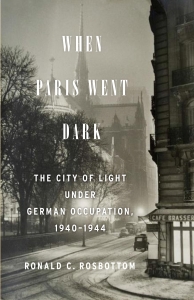 There are many stories about what happened in France during the German Occupation—almost as many stories as there were people who lived them. For some, France was filled with resisters who sabotaged the Nazis at every turn. For others, it was about the shame of collaboration. The truth, as is often the case, is both broader and more complex than either of these extremes would suggest.
I know; my family lived in France through the second world war, and, like most French families, has troubles articulating its role in the four years of the Occupation. Those years (and the strange ways in which they affected the nation’s consciousness) are explored in When Paris Went Dark, by American professor and author Ronald C. Rosbottom, and the ambiguities outlined:
“Even today, the French endeavor both to remember and to find ways to forget their country’s trials during World War II; their ambivalence stems from the cunning and original arrangement they devised with the Nazis, which was approved by Hitler and assented to by Philipe Petain, the recently appointed head of the Third Republic, that had ended the Battle of France in June of 1940. This treaty — known by all as the Armistice — had entangled France and the French in a web of cooperation, resistance, accommodation, and, later, of defensiveness, forgetfulness, and guilt from which they are still trying to escape.”
On June 14, 1940, German tanks entered a silent and nearly deserted city. Eight days later, France accepted a humiliating defeat and foreign occupation. Subsequently, an eerie sense of normalcy settled over the City of Light. Many Parisians adapted themselves to the situation, even allying themselves with their Nazi overlords. At the same time, amidst this darkening gloom of German ruthlessness, shortages, and curfews, a resistance arose. Parisians of all stripes—Jews, immigrants, adolescents, communists, rightists, cultural icons such as Colette, de Beauvoir, Camus and Sartre, as well as police officers, teachers, students, and store owners—went from small acts of resistance to overt acts of terrorism.
Paris in those years was “a city where many, many young and middle-aged men were in prison, concentration camps, in hiding, or in the underground,” so almost by default the Resistance became in significant measure a movement of the young and of women and girls, without whom “the Parisian resistance, no matter its ideology, could not have been as successful as it was.” And in the middle of all this, there remain “the ethical questions that would haunt France for decades: Which actions, exactly, constitute collaboration and which constitute resistance?”
One of the most often-asked questions about the Occupation of Paris concerns how and when its citizens resisted the imposition of a foreign host. Why was the city surrendered without a shot being fired? What sort of organized resistance developed? How unified were the different groups who did resist? What forms did that resistance take, and why was it not more successful? In the end, is it true that the French were more passive than active in their acceptance of German authority?
The main character of this book is Paris, both the geo-political site as well as the imagined one. There are many, many references here to specific streets and boulevards, métro stops, neighborhoods, monuments, restaurants, cafés, churches, museums, cemeteries, parks, hotels and more.
In some ways, this is a retroactive guidebook, for the city that the Nazis occupied has not changed much in the last seventy years. The other story is how two complex national and cultural entities—Parisians and Germans—reacted to each other, how they lived in an intimate embrace where the moves or caresses of one brought forth a reaction from the other. Neither was strong enough to control the other, but slowly, because of fatigue rather than strength, one finally manages to break away.
The story of the Occupation of Paris fascinates us the same way that fictional works imagining the Nazi occupation of London or New York do. How can a city so well known—thanks to poetry, fiction, history, film, painting, photography, postcards, songs and the innumerably recounted visits of thousands upon thousands of world tourists—adapt to a sudden jolt that, unlike an earthquake or even a plague, lasts much, much longer than expected?
It’s not a comfortable read, but it’s an important one. Thanks to the author’s tireless research and interviews with hundreds of Parisians, the reader is able to enter into the experience, ambiguities and all. Highly recommended.
-
Here There Be Dragons
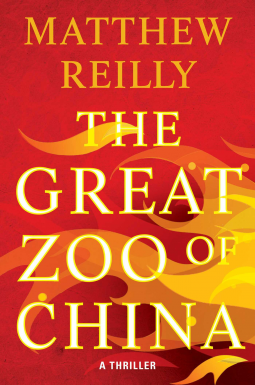
Posted: December 14th 2014 @1:57 PM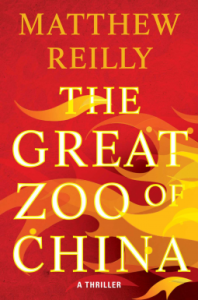 Matthew Reilly’s new thriller, The Great Zoo of China, has action. Lots of it. On every page.
Of course, a lot of action does not necessarily a novel make, and when even the most exciting of sequences is repeated too many times it becomes old. Really old. I was surprised to find myself scanning rather than reading page after page of this supposedly taut thriller: she’s in danger again. Oh, look, she’s in danger again! Oops, in danger again. In… danger… again.
Let’s start with the premise, which will strike anyone remotely familiar with Michael Crichton’s Jurassic Park as derivative. The Chinese government has been keeping a secret for forty years: they’ve found a species of animal no one believed even existed and are ready to unveil their astonishing discovery inside the greatest zoo ever constructed. A small group of VIPs and journalists is brought to the zoo to see its fabulous creatures for the first time. And, naturally, things go wrong. Really, really wrong.
 Yep. You see where we’re going with this. And the author does so faithfully, building tension with hints and foreshadowing, even adding the requisite beast-chasing-human-in-the-industrial-kitchen scene.
To do him justice, Reilly has given the premise a lot of thought. His zoo is well-designed and well-explained, and the visuals that rise off the book’s pages are nothing less than stunning. He supplements them with charts and maps that some readers may appreciate, and gives us character sketches that, while predictable, do manage to engage. He’s paid attention to everything about the creatures in the zoo, from birth to feeding habits to rituals and behaviors, and maintains a consistency within his science fiction that makes it seem plausible. That’s all good.
I’ve done an episode on The Writer’s Toolkit here on WOMR that addresses the necessity for fiction to maintain forward momentum. You’d think that a novel in which people are fighting, running, hiding, getting killed (gruesomely) and performing feats of acrobatic impossibility (seriously, we haven’t seen anyone moving around the outside of a vehicle with such mobility since the unfortunate movie Speed) would have that forward momentum, but the reality is that momentum is maintained by changes of pace, and Reilly doesn’t have them: after the setup, he’s at 100%, 100% of the time.
Still, if you’re looking for something to help you while away a couple of hours in total escapism, The Great Zoo of China is a good candidate. It’ll be out in January from Gallery Books (a division of Simon & Schuster) and if you have an action-lover on your gift list, you can preorder it today.
-
Paint and Sip at Terra Luna
Posted: July 5th 2014 @5:57 PM Love to paint? Never painted before? Somewhere between the two? No matter. There’s a seat for everyone at Terra Luna’s Thursday afternoon Paint and Sip.
Under the expert guidance of artist Colin McGuire, wine and appetizers are consumed while pictures take shape on canvas almost as if by magic. McGuire selects a painting by a master—this past week it was Van Gogh—and uses that masterpiece to teach participants about color, light, and form. “I break it down into its simplest form,” he explains. “We start with three or four big shapes and work in from there.”
 It’s not a new concept, and is often done en plein air (McGuire himself has done similar classes in Puerto Rico), so bringing it to the outer Cape, home of American plein air painting, seemed an obvious choice. And Terra Luna, with its inviting atmosphere and lovely garden, is ideally suited for the event. Visitors looking for an alternative to beaches and museums, locals looking for a break from the traffic and fatigue of working too many hours—there’s something here to de-stress everyone. Even yours truly: I’ve always held to the firm belief that as a visual artist, I’m an excellent writer; and I’m not sure that opinion has changed radically—but what I will say is that I had a lot of fun. (more…)
 -
Freud’s Last Session Explores Gray Areas with Depth and Warmth
Posted: June 25th 2014 @3:28 PMGood versus evil. Black versus white. Atheist versus believer. Playwright Mark St. Germaine sets us up in Freud’s Last Session (now at the Cape Playhouse in Dennis) to believe that we’re about to witness the extremes doing battle; what the audience doesn’t reckon with is the characters’ understanding and exploration of the gray areas between the two.
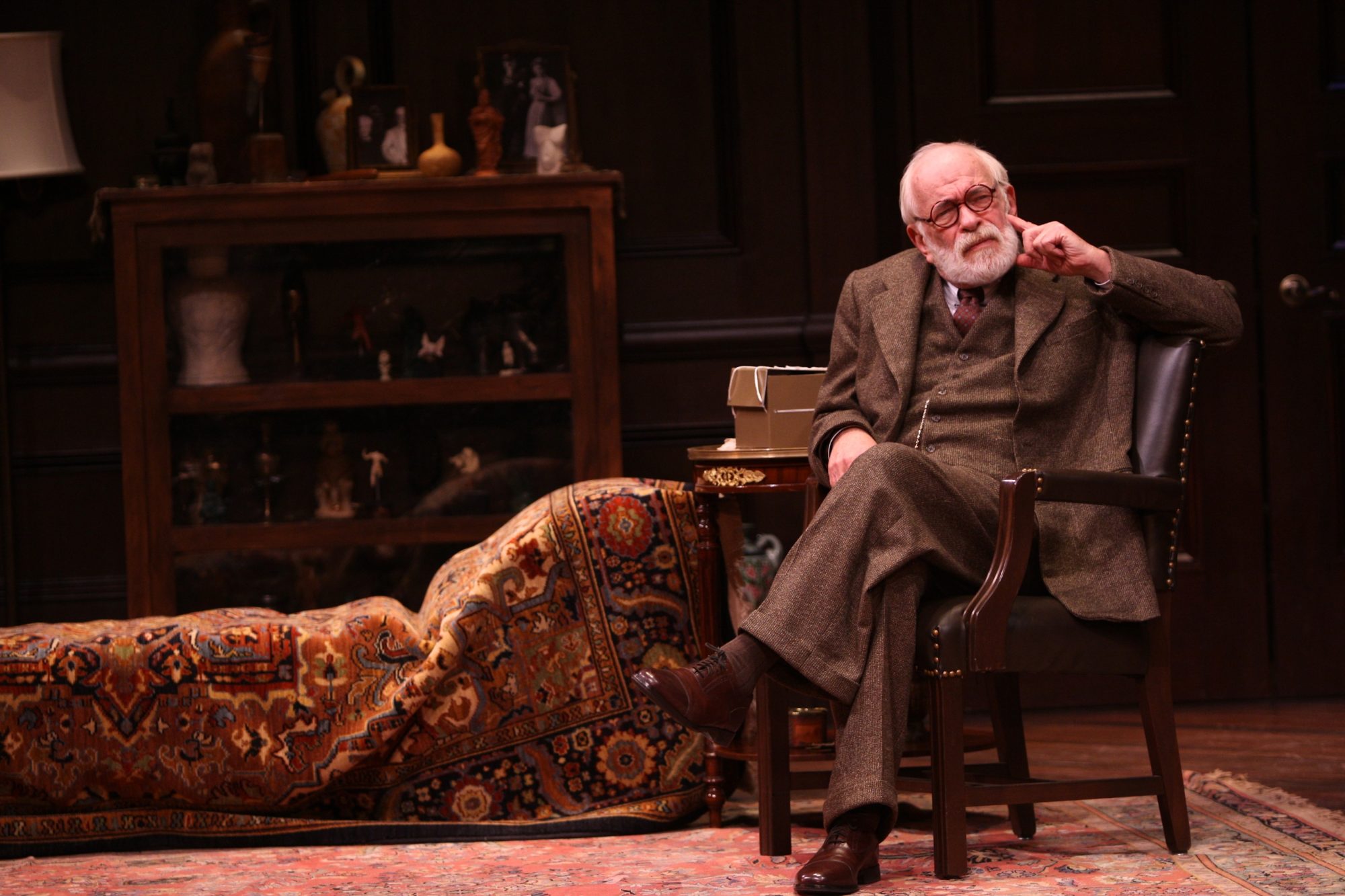
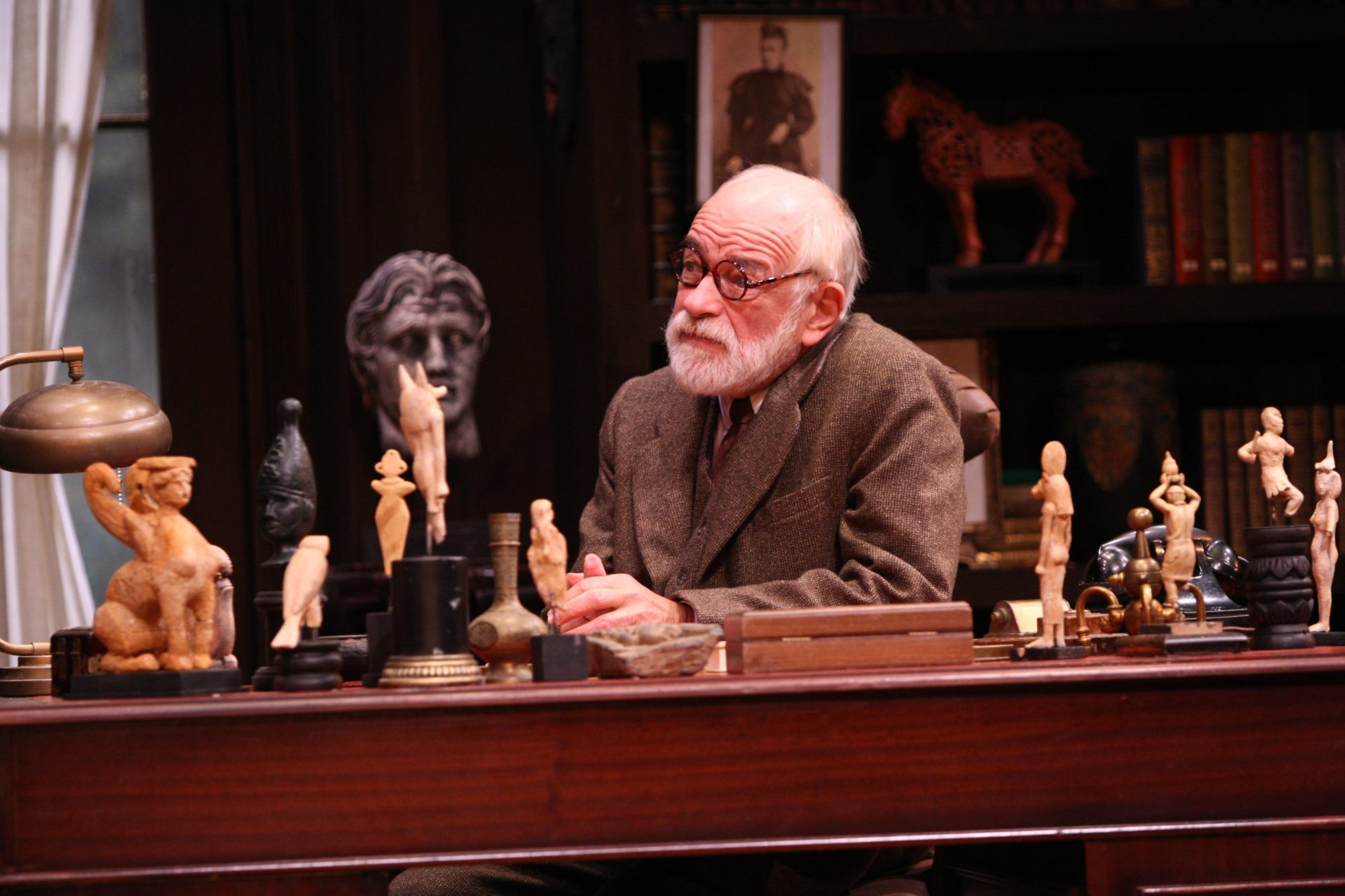
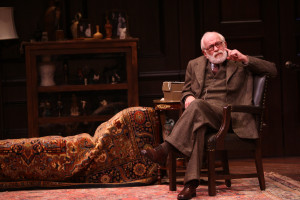 We are in Sigmund Freud’s London study (and anyone who loves books and learning is going to covet Nicholas Dorr‘s set immediately). The psychoanalyst has fled Vienna and on this morning is pondering his own death—which he will soon hasten—as well as Germany’s invasion of Poland. He is about to be visited by an Oxford don, Clive Staples Lewis, who at one time shared Freud’s atheism but has recently converted to Anglican Christianity. Lewis has criticized Freud in print and fears that he’s been invited here to be given a dressing-down from the great man.
St. Germaine’s choice of these two real personalities for his fictional conversation is enlightened: while modern audiences know Lewis primarily as the author of recently re-popularized children’s books, he was in fact after his conversion a lay theologian, not blindly accepting of dogma but rather bringing his incisive mind to wrestle with the problems presented by faith.
What is immediately a little disconcerting in the opening scene is the sense that one is, actually, in the presence of Freud himself. Kenneth Tigar—who comes to the Cape Playhouse having already performed the role at Hartford’s TheaterWorks and Geva Theatre Center—just looks like every extant photograph of the psychoanalyst. And he remains completely in the physicality of an old man throughout the play: every movement, every expression, every word is clearly that of an aged and infirm person. This is not easy to maintain and Tigar does it to perfection.
As Lewis, Jonathan Crombie—who played the role opposite Tigar in Hartford—is less like his real-life character physically, but does a good job of strongly countering the more verbally and even physically flamboyant Freud. Lewis is logical and rational, and calm—until his own defenses are stripped away during an air-raid signal—and Crombie allows both sides of the Englishman to emerge: the intellectual Oxford don and the frightened young soldier.
The actors move from epigram to epigram without missing a beat. The play is filled with bon mots, most of them Freud’s, and at one point Lewis looks pointedly at the analyst’s couch and says, “There’s no avoiding this, is there?” No: it’s clear that there isn’t.
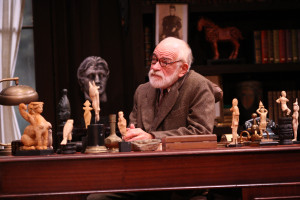 After a great deal of extremely entertaining sparring, the men get down to brass tacks—the problems inherent in belief. Freud dismisses the New Testament: “These are myths and legends!” he exclaims, while Lewis calmly counters, “But does that make them lies?” He presses his point: the New Testament cannot be only comprised of myths, he says, it’s simply not imaginative enough. Freud has the last word: “You’re convinced of Christ’s existence because of bad storytelling?”
The situation is, of course, absurd on one level: the play is punctuated by the war that is just beginning: Neville Chamberlain and King George’s voices on the radio, an aborted air raid, the seizing of gas masks. Freud uses the situation to attack the Gospel message once more: “Should Poland turn the other cheek?” he demands.
The men discuss sexuality, the dynamic that lies at the center of Freud’s worldview; they remain distanced from each other in their beliefs but as the play draws to a conclusion there is the predictable personal rapprochement, enabled by Freud’s sudden painful physical crisis and the need for an immediate intimate connection. Each admits finally to his own weakness and Lewis ruefully remarks, “It was madness to think we could solve the world’s problems in one morning,” to which Freud responds, “The greater madness is not to think of it at all.”
Geva Theatre Center’s Skip Greer‘s direction is light and never goes over the top into too much confrontation, too much pathos, or too much of any strong emotion for that matter. He allows the audience the play’s moments of humor that balance the serious issues under debate but then with a deft hand pulls back into the flow of the conversation.
A lifelong admirer of Lewis’, I left this performance moved and thoughtful. Anyone with an interest in the gray areas between religion and atheism will find enough here to occupy their thoughts long after the play is over—which is, after all, one of the reasons one goes to the theater: to be challenged in an entertaining way. The Cape Playhouse’s production of Freud’s Last Session does just that.
***
Jeannette de Beauvoir is the host of Arts Week on WOMR, a contributing writer to Provincetown Magazine, and a novelist, editor, and marketing writer. More about her at linkedin.com/in/jeannettedebeauvoir
-
One Man, Two Guvnors, Lots of Laughter
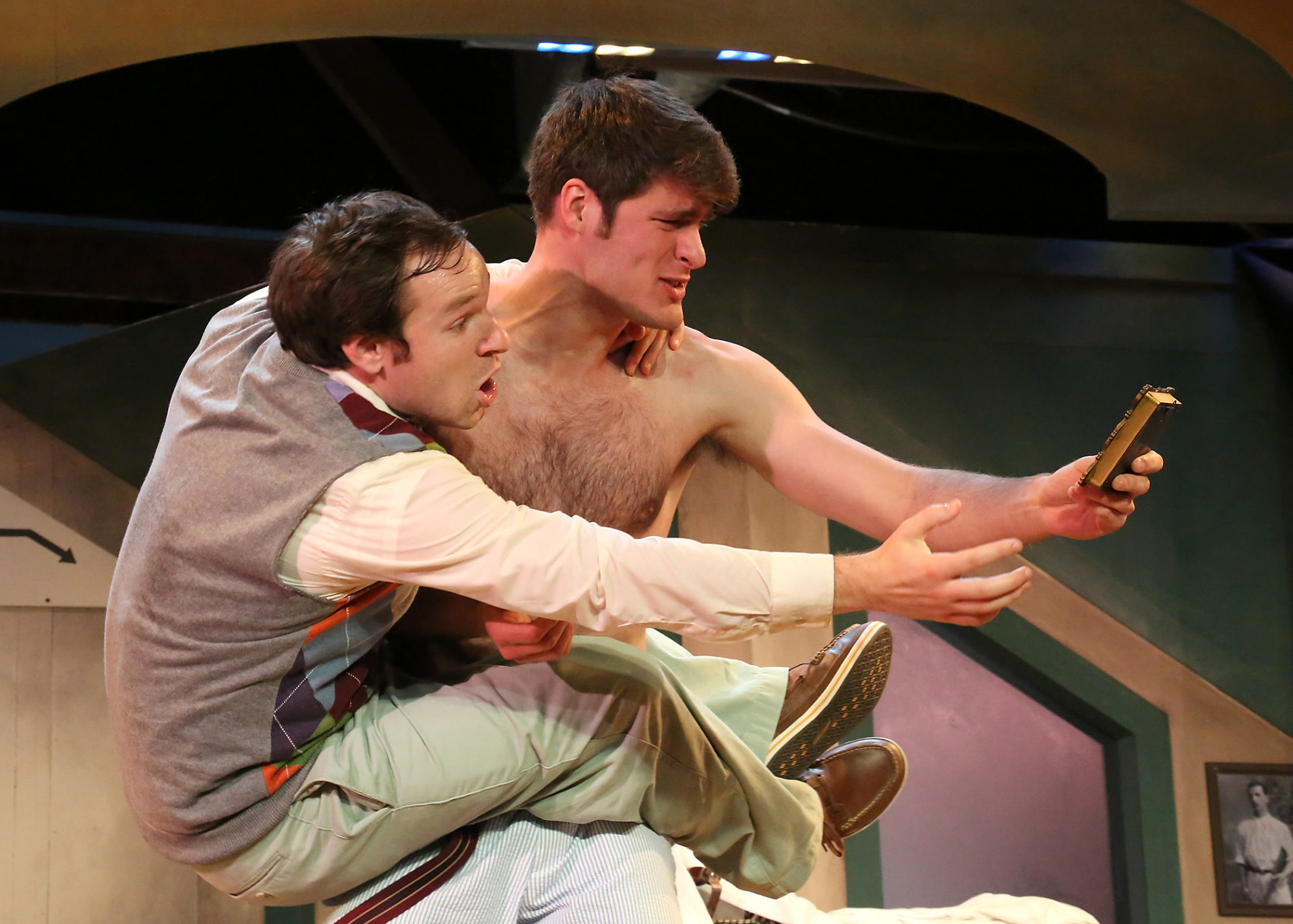
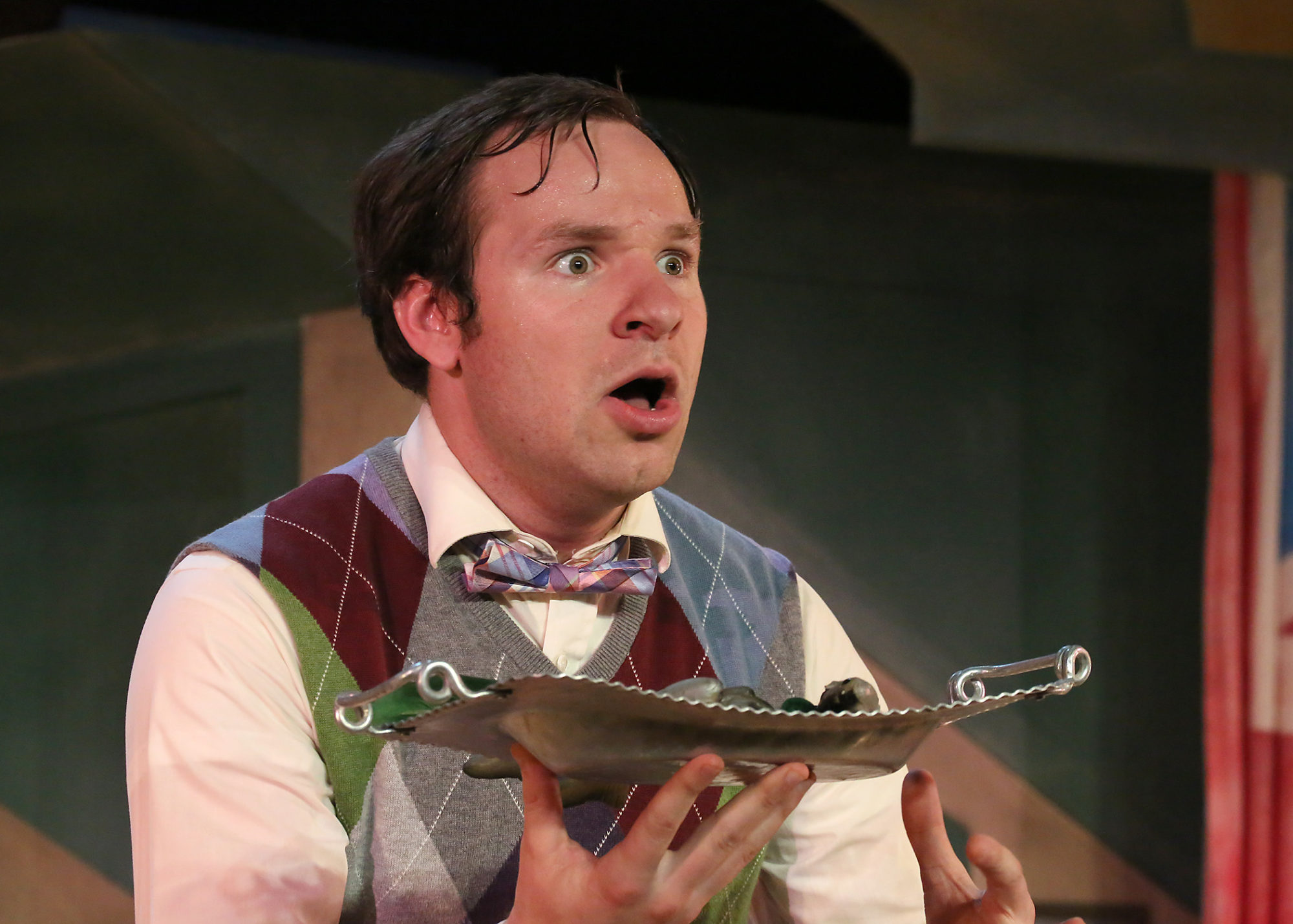
Posted: June 24th 2014 @6:13 PM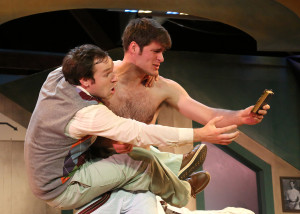 My fellow Frenchpeople’s obsession with Jerry Lewis notwithstanding, I’ve never been a big fan of slapstick humor: a little, in general, goes a very long way indeed. Imagine my surprise, then, when I found myself not just laughing out loud at the Cape Rep’s production of One Man, Two Guvnors, but with tears of mirth streaming down my face as well. I stopped taking notes. I stopped noticing anything but the stage and the story and my own aching sides.
That’s the sort of production it is: quick, clever as well as slapstick, and enormously engaging. We’re immediately transported to 1960s Britain, complete with a Buddy Holly-esque band (and the music is really excellent), clothing that makes us grateful that fashion has evolved, and a very young Queen Elizabeth in photographs on the wall.
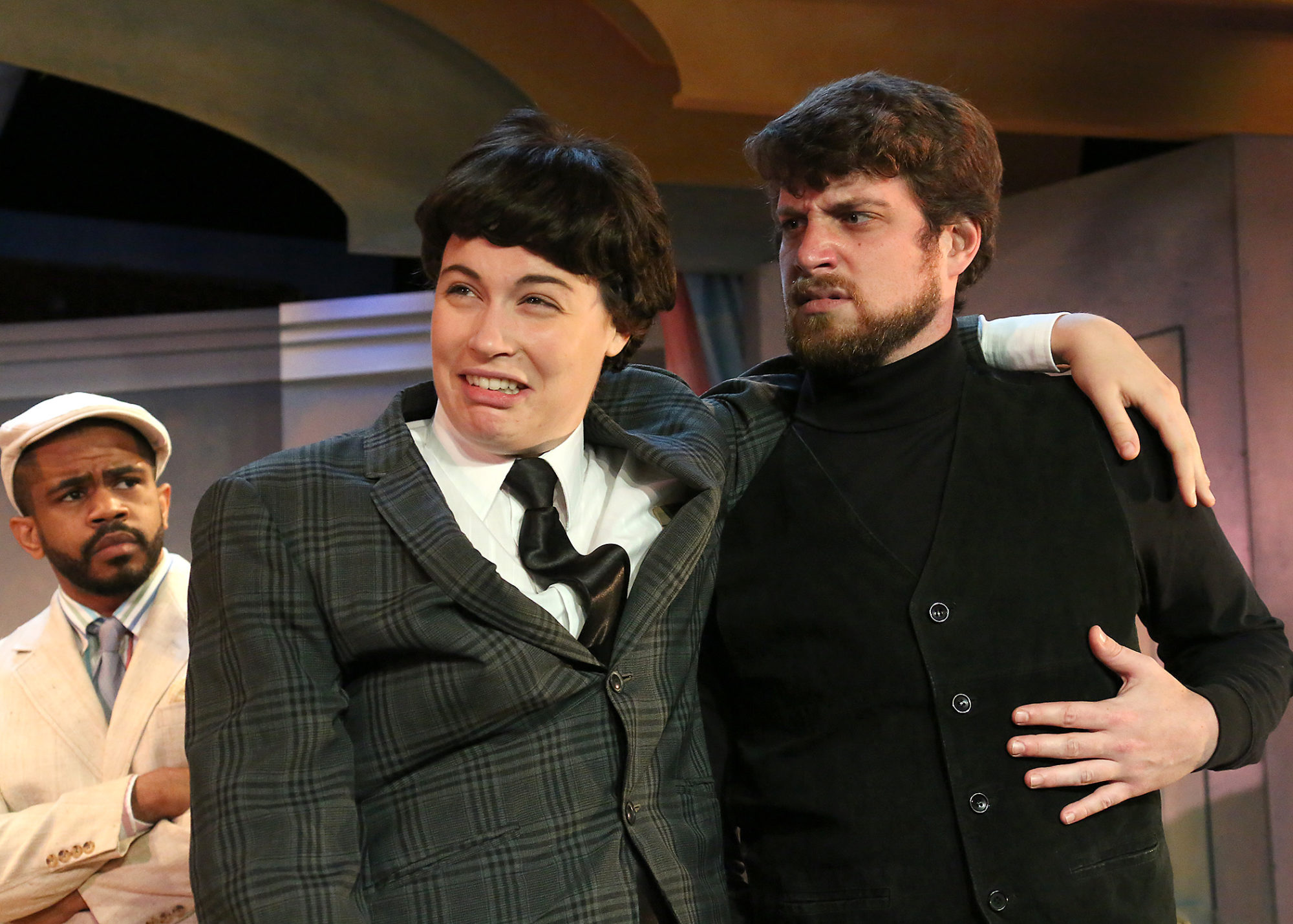
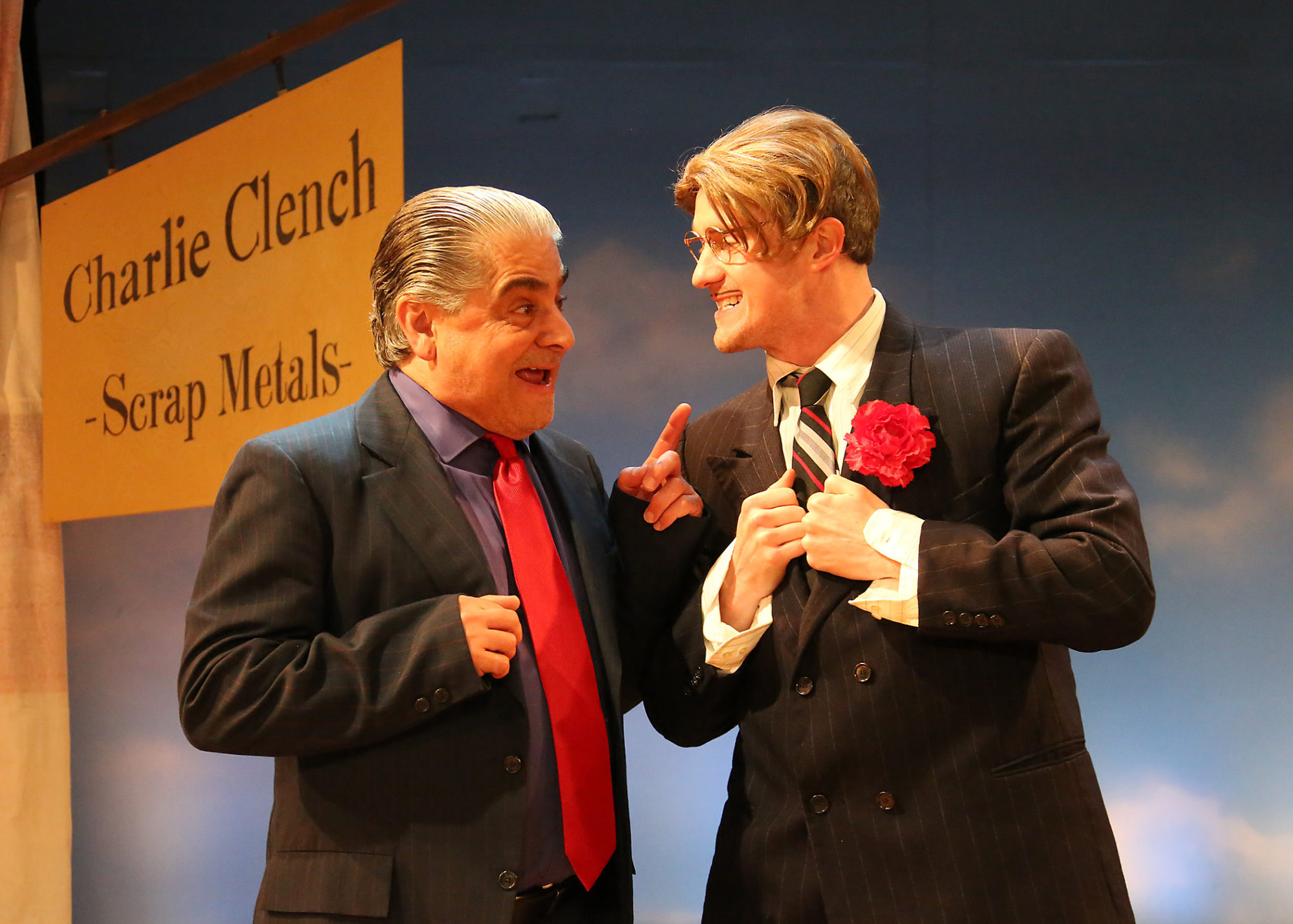
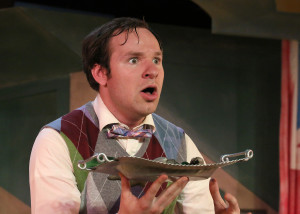 Let’s start with plot basics: Francis Henshall, a failed skiffle player, finds himself working for a local gangster at the same time as he takes a job with a criminal in hiding; both bosses, as we would say on this side of the Pond, are linked together in a very tangled web of romantic aspirations, about-to-fail schemes, and family ties. One of the two employers, Rachel, is a woman disguised as her dead gangland twin: the other, Stanley, is an idiotic clotheshorse, who is both the twin’s killer and Rachel’s lover. Francis is hopeless at keeping the various associations linked to the correct employer, and his solution is to try and keep the two from ever meeting. His own ongoing hunger and willingness to go along with whatever situation presents itself move him into the stuff of farce.
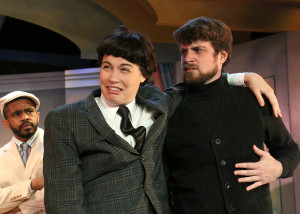 I expect that much of the reason I found this slapstick enthralling is that it wasn’t limited to physical pratfalls: playwright Richard Bean made this show verbally funny as well, and his script is peppered with observations such as “first names are for girls and Norwegians,” and the ever-present threat of Australia as offering a “terrible outdoor life, sustained by barbecue, beer, and opera.”
Brighton is a brilliant setting: as the late Keith Waterhouse has written, “Brighton is a town that always looks as if it is helping police with their inquiries.” Here mobsters (cross-dressing or not), pathetically stupid women, self-obsessed failed actors and efficient bookkeepers are the order of the day. (Sorry, Zoe Lewis: by the time you arrived, Brighton had no doubt cleaned up its act!)
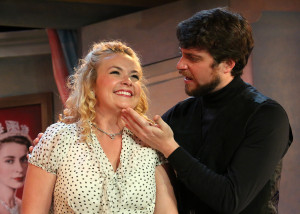 As is consistently the case with Cape Rep, every inch of the stage is used to great advantage. We move seamlessly (with the help of the band) from a parlor to a street to a questionable restaurant, even to a bridge for a dramatic suicide attempt, and all of it done without the audience noticing the transformation.
I’d take some time to single out the best actors, but I’d simply be listing the cast, because everyone was absolutely perfect in their roles. No one missed a line or a beat, the timing was spot-on, and their smoothness in working with and off each other superb.
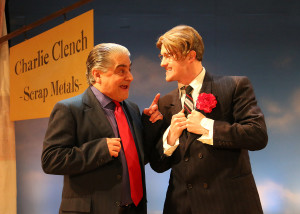 A word of warning: sit in the front row at your own risk. Seton Brown, as Francis, is not only dealing with a complex set of verbal and physical requirements, he’s also ad-libbing at every performance as well. Enough said. Brown delivers some impressive physical feats (have you ever seen anyone jump over an ironing board before?), while Jonathan C. Whitney manages to deliberately and delightfully convey caricature onstage.
Over the top? You bet! But I’ll bet that you’ll come away from Cape Rep’s One Man, Two Guvnors wheezing with laughter.
One Man, Two Guvnors by Richard Bean, based on The Servant of Two Masters by Carlo Goldoni and directed by Fred Sullivan, Jr., plays at Cape Rep from June 19th to July 19th. (Photo credit: Bob Tucker/Focalpoint Studio)
***
Jeannette de Beauvoir is the host of Arts Week on WOMR, a contributing writer to Provincetown Magazine, and a novelist, editor, and marketing writer. More about her at linkedin.com/in/jeannettedebeauvoir
-
Adam Graham’s Provincetown Vision
Posted: April 24th 2014 @2:12 PM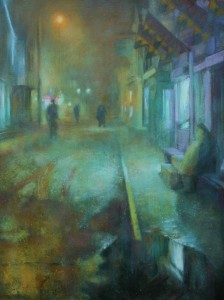 Artist Adam Graham was my guest this week on Arts Week (check out the podcast of the show if you have time), and I was impressed not only with his work—which is flat-out gorgeous—but also with his passion and articulation in talking about it.
Here’s his bio and artist statement:
“Adam Graham began studying impressionist painting under the guidance of his father, painter Bob Graham, who was a longtime pupil of Henry Hensche.
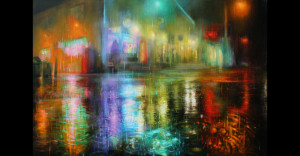 “Adam moved from his hometown of New Orleans in 1999 to further study the Henshe impressionist method at the Cape Cod School of Art under the tutelage of Lois Griffel. His interest is in using the principles learned painting en plein air for the last 11 years and applying them to new and original motifs.
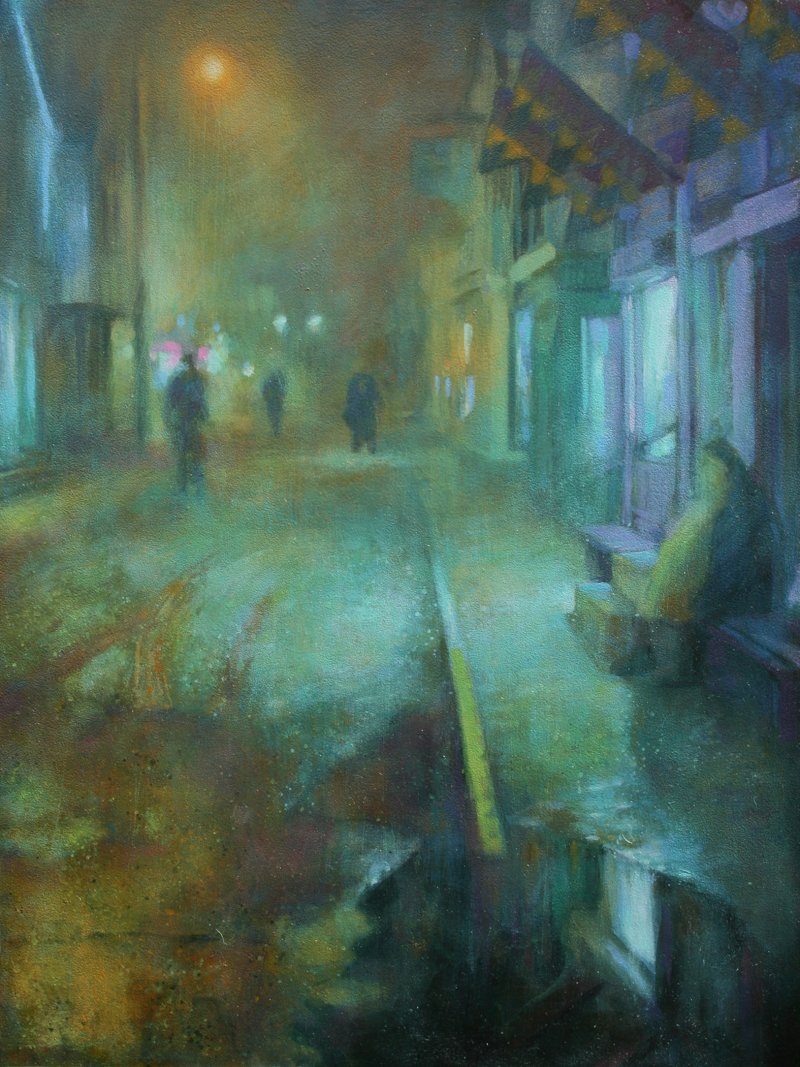
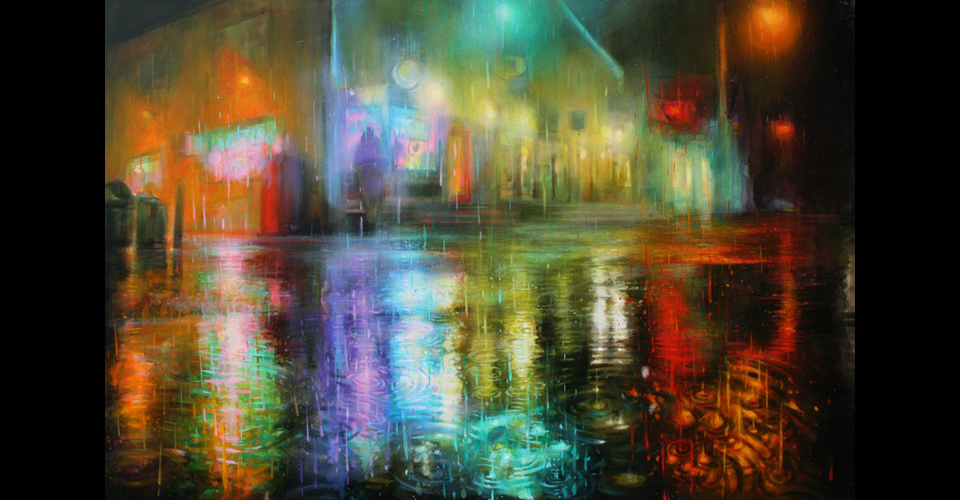
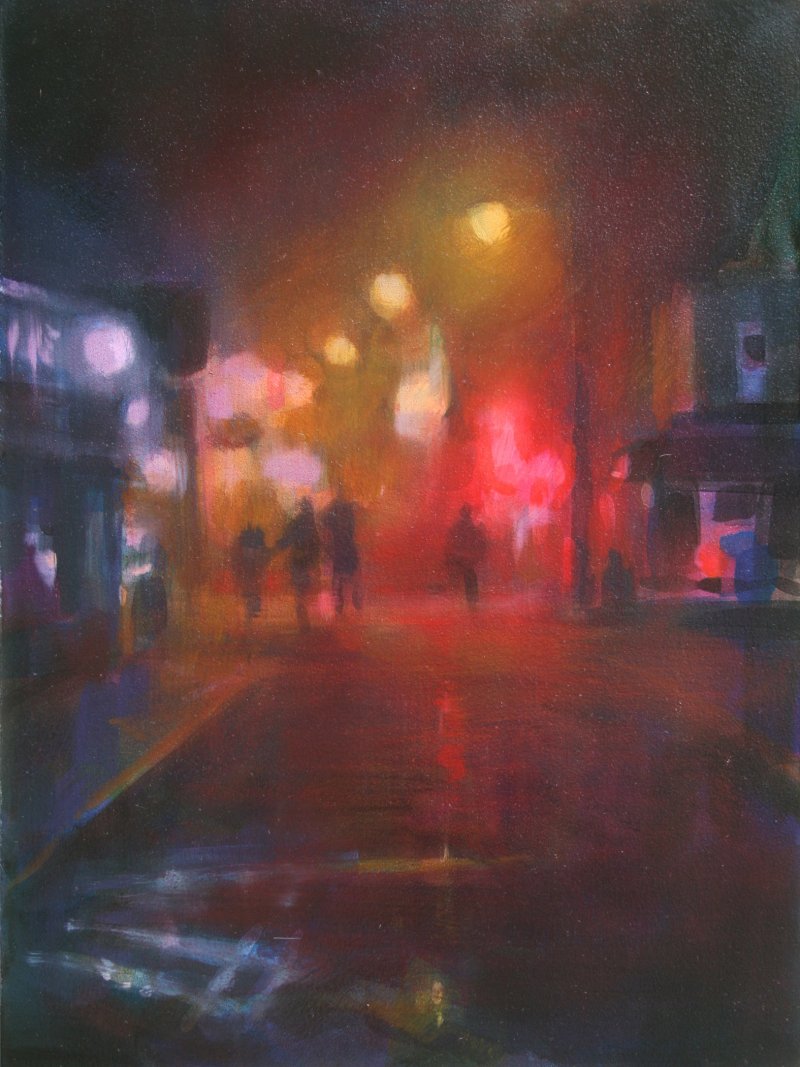
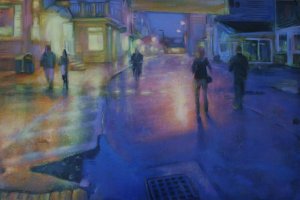 “Artificial light at twilight is Graham’s main focus. The time of day when the world takes on an indigo glow and is punctuated with glimmering street lights. Dark shapes take on new form and the ordinary world becomes a waking lucid dream.”
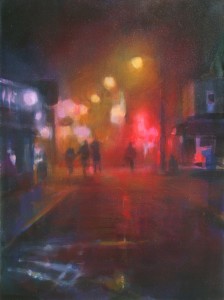 Looking through his work (as you can when you visit his website), I’m struck by how important is the sense of place. It’s always comforting to recognize a place or a person in works of art—one feels somehow connected to the artist and his creativity that way—but what this artist does is give one a radically different perspective on scenes familiar to us through everyday proximity. The giant ice cream cone outside of Twisted Sister becomes ominous under Graham’s brushwork, while seeing the streets from a frog’s perspective allows and invites the viewer to look at them with fresh eyes.
Graham is represented by the Rice-Polak gallery in Provincetown. They’ll be opening for the season soon; make sure you stop by to see his work.
***
Jeannette de Beauvoir is the host of Arts Week on WOMR, a contributing writer to Provincetown Magazine, and a novelist, editor, and marketing writer. More about her at linkedin.com/in/jeannettedebeauvoir
-
From Whaling Capital to Whale Conservation
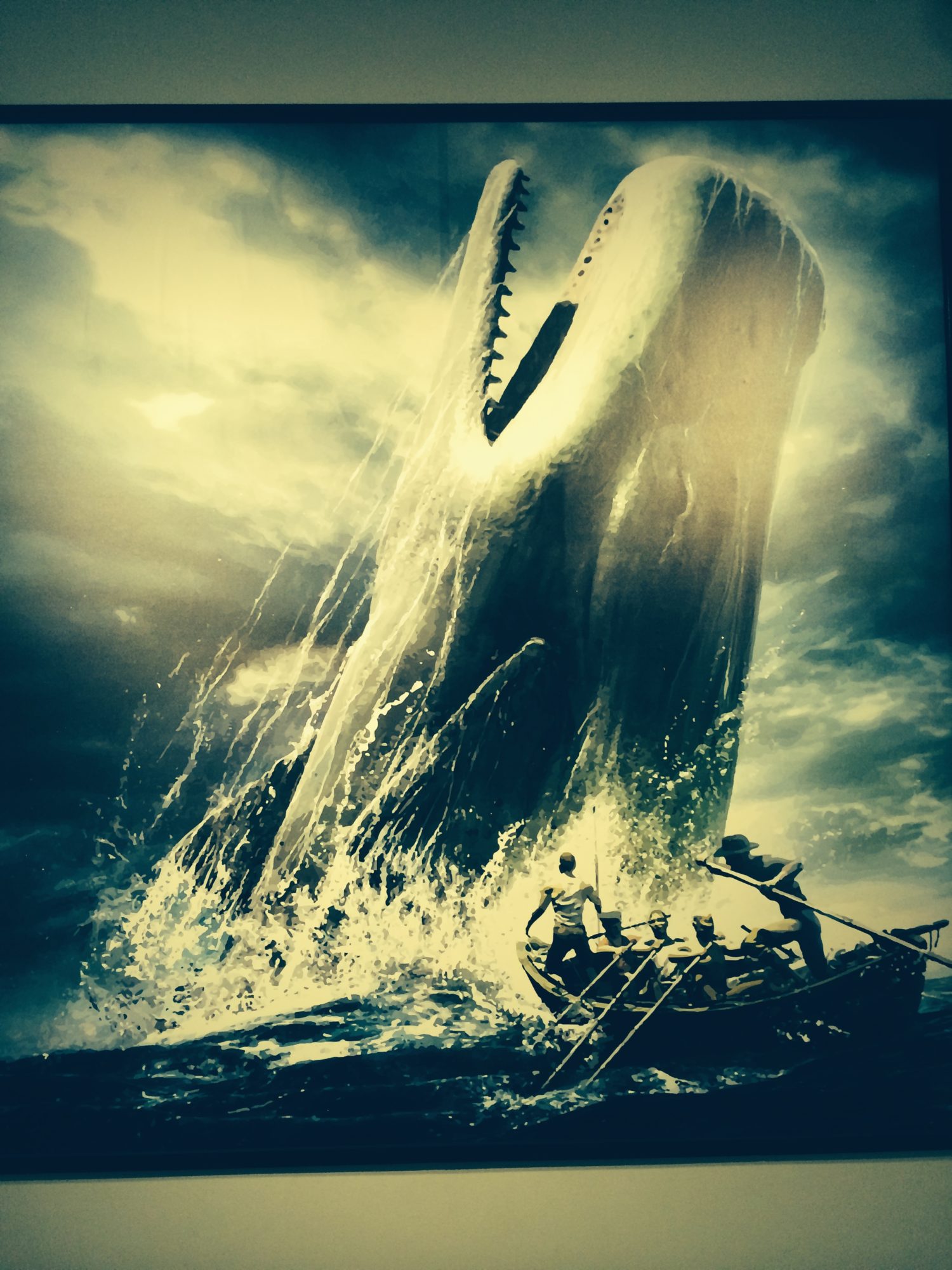
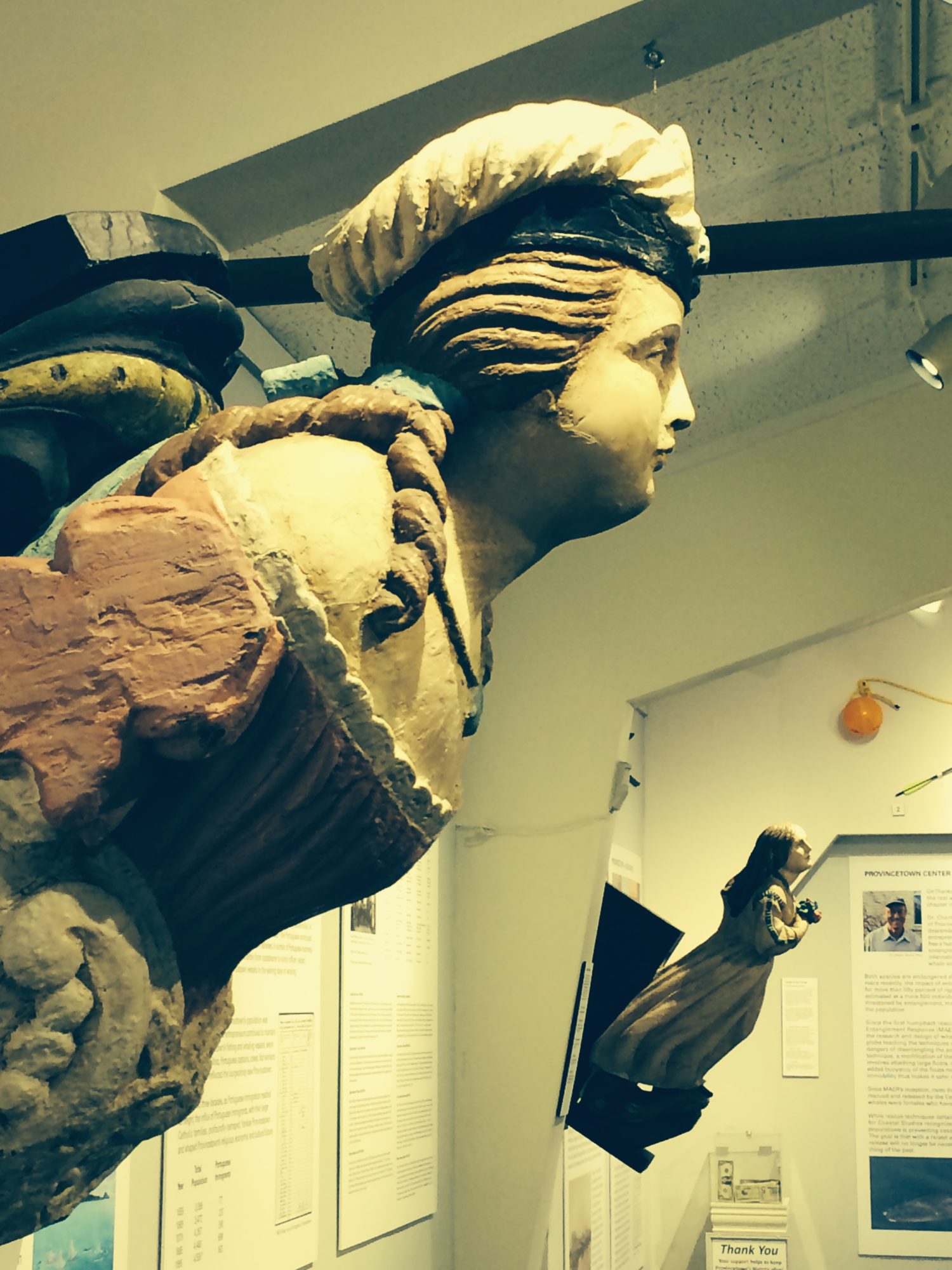
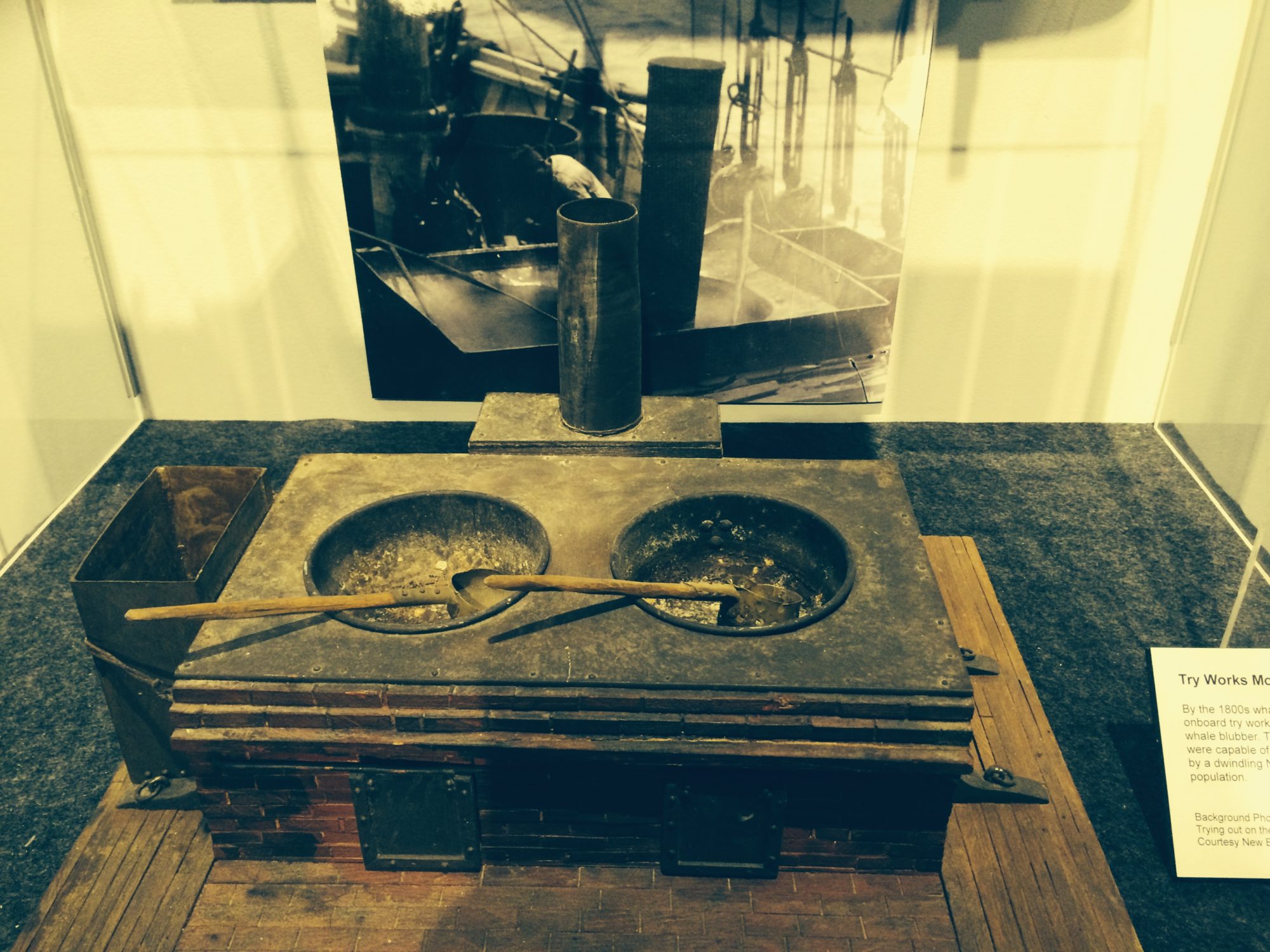
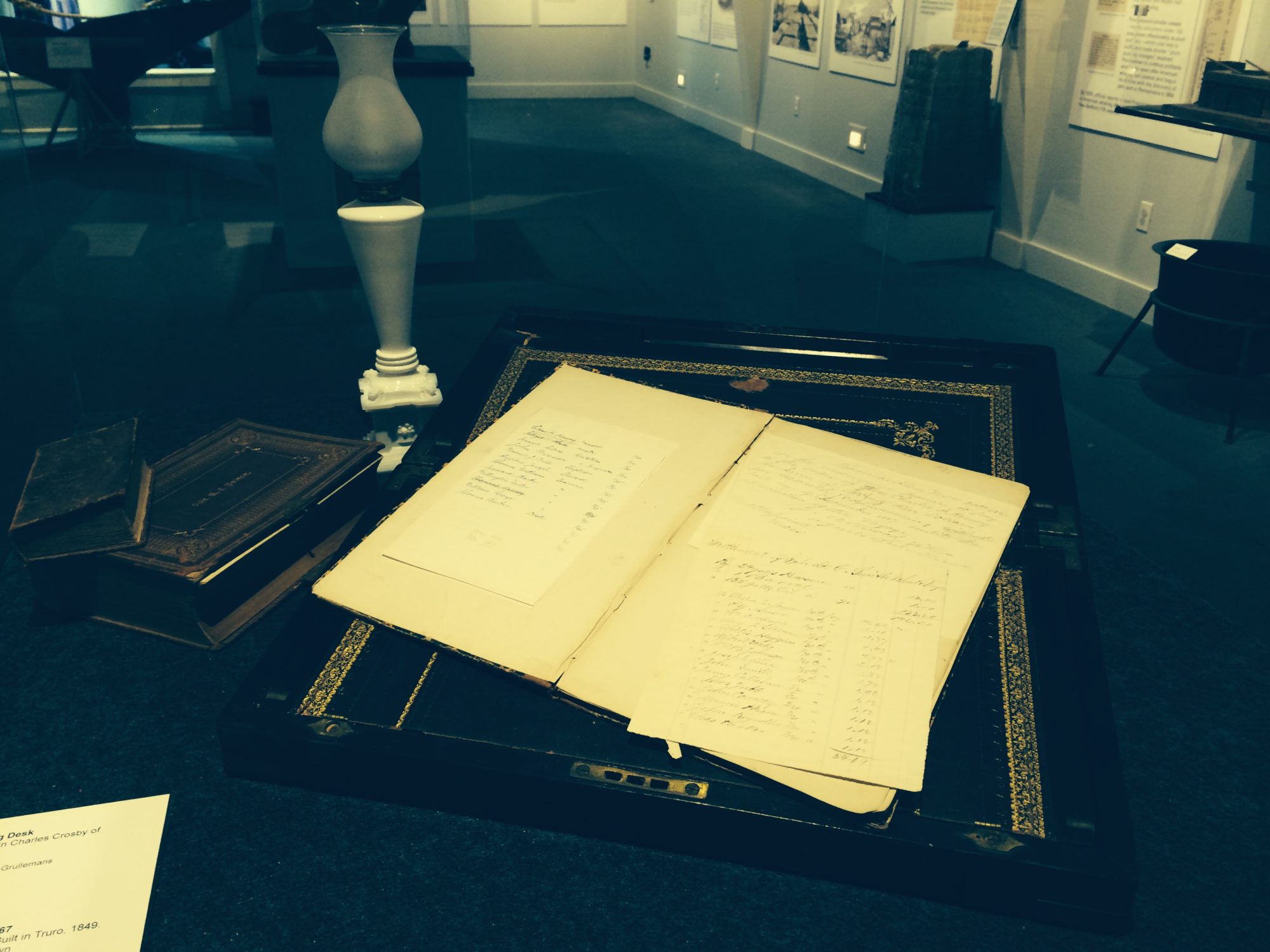
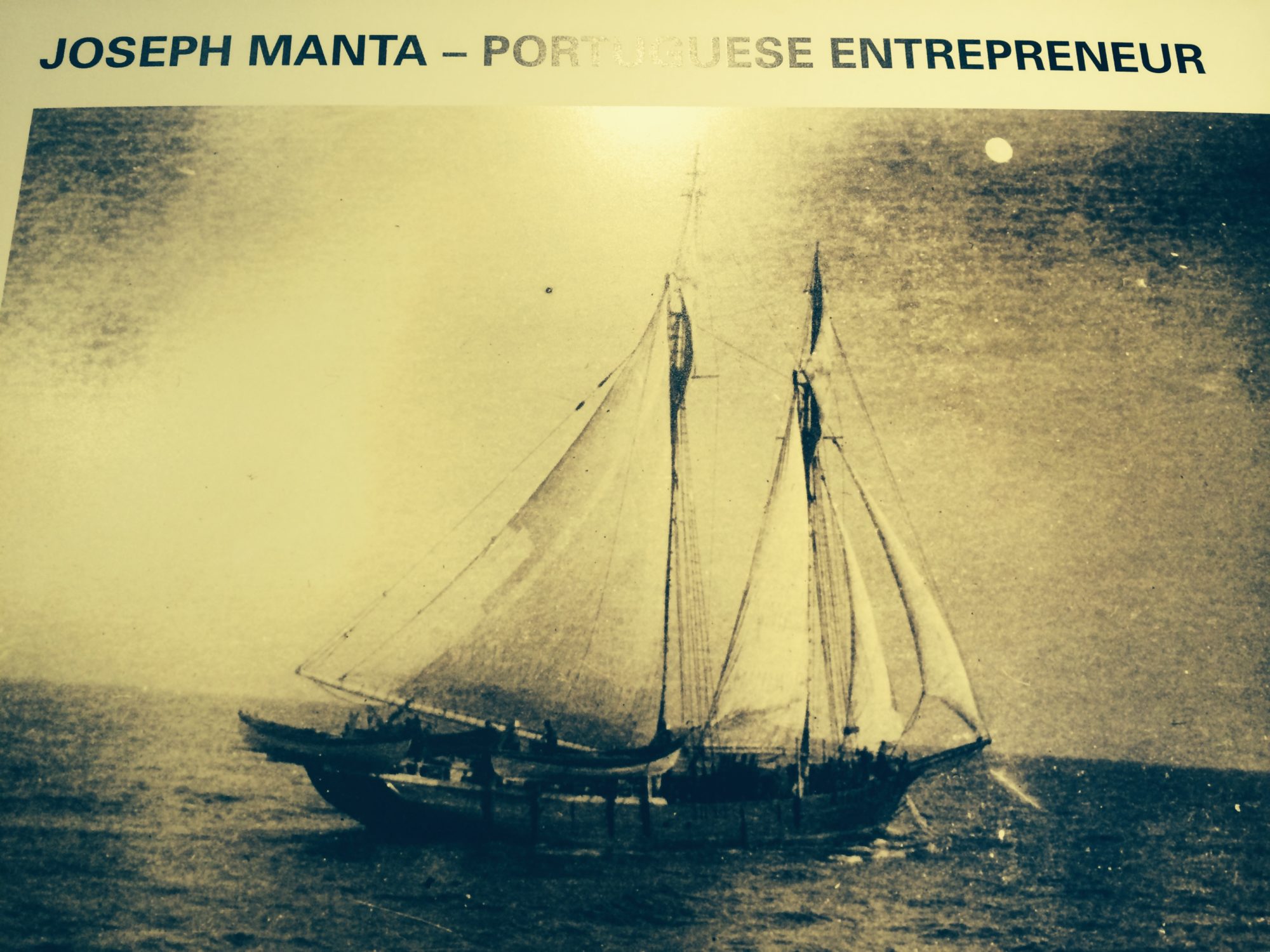
Posted: April 11th 2014 @11:17 AM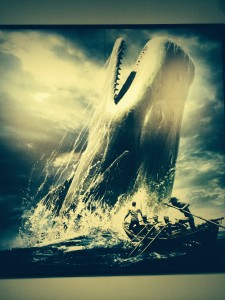 There’s a new exhibition at the Pilgrim Monument and Provincetown Museum called Forgotten Port: Provincetown’s Whaling Heritage, and no matter whether you’re a native, a washashore, or a visitor, there’s something there for you.
It details the story of how Provincetown evolved from hunting whales to saving them, with a special emphasis on the whaling days and how they helped PTown forge its identity. Once visitors get past the “ewww factor” inherent in hindsight (i.e., how horrible that they did this, wasn’t it awful, I don’t like to think about it, etc.), this study in how an industry supported a town is fascinating.
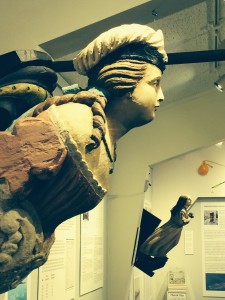 John McDonagh, executive director of PMPM, has said that “Forgotten Port is a story that hasn’t been told. Few realize the fundamental and enduring impact of the whaling industry in shaping the town’s economy and culture. Because of whaling, by 1870 Provincetown was one of the richest towns in Massachusetts and second in American whaling, rivaled only by New Bedford.”
The exhibit is rich in narration, with snippets of information about whaling captains, whaling vessels, life onboard and life onshore, always allowing visitors to absorb the information at their own pace. See how sperm oil both illuminated and lubricated the industrial revolution; read the memorial to the wreck of the Rienzi; follow the Yankee and Portuguese captains and crews; learn about the family that built the Figurehead House.
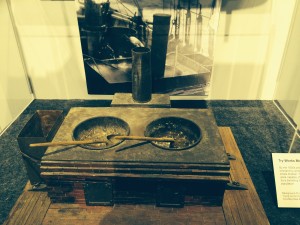 Along with the written narrative, you can follow images, artifacts, videos and voice recordings that create together a whole picture of the life of one of America’s most important whaling ports. The museum is also continuously running the film Whaling Days, the only film made of a whaling voyage—and, honestly, not for the faint of heart. You can also see it on YouTube. It was commissioned by Captain John Atkins Cook (who recorded it on the whaling ship Viola) and shows him leading the actual hunt, the capture, and the rendering of whales onboard.
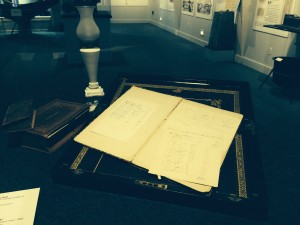 The history brought alive here starts with Provincetown’s early whaling days and the “drift whaling” practiced by the Wampanoag and early white settlers. It moves into Provincetown’s “golden age” of whaling, showing the details behind the statistics that between 1820 and 1920 more than 160 whaling ships left and returned to Provincetown, ranking the town fifth in vessels and third in voyages among 72 American ports. The final days of whaling are illustrated with the decline of whale stocks, and finally, the rise of ecotourism and the will to protect cetaceans are documented.
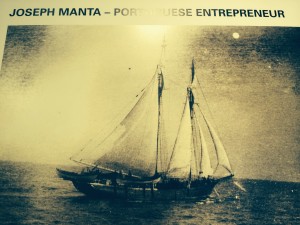 There’s a strange connection between the past and the present: Provincetown Center for Coastal Studies president Richard Delaney says, “Today we’ve modified the same tools that were used to catch whales in order to save them. By turning around the point of the harpoon that was used to catch them, we can now cut the ropes and free them.”
Coming full circle from using to enjoying whales, this exhibit is well worth everyone’s time… and thought. Every generation leaves its mark on the places it inhabits, and reflecting on the marks of past generations while looking to the future is surely one of the most important of endeavors.
Want to go? Forgotten Port: Provincetown’s Whaling Heritage is open April 1 through November 30, 2014. The Pilgrim Monument and Provincetown Museum collects, preserves, interprets, researches, exhibits, and publishes archival historical materials and exhibit materials depicting important events of Provincetown history. Open Daily 9 – 5 April 1 to Memorial Day, then 9 – 7 to Labor Day, and 9 – 5 to Nov. 30. Admission is $12 adults, $10 seniors, $4 children 4 – 12, 3 and under free. Parking is free every day through April. In May, parking is free Monday through Friday. until Memorial Day.
For more information, visit the Pilgrim Monument and Provincetown Museum, call 508-487-1310, or follow PMPM on Facebook and Twitter.
***
Jeannette de Beauvoir is the host of Arts Week on WOMR, a contributing writer to Provincetown Magazine, and a novelist, editor, and marketing writer. More about her at linkedin.com/in/jeannettedebeauvoir
-
Martin Sherman’s BENT at the Provincetown Theater
Posted: March 17th 2014 @9:02 AM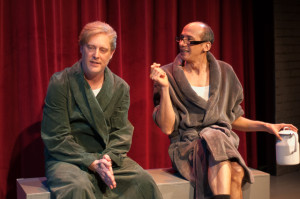 Michael Steers’ production of Bent at the Provincetown Theater takes its audience—irrespective of sexual preferences—to places that no one wants to go, and does so with refinement, dignity, and—occasionally—humor. Bent targets everyone: it questions the meaning of self, it examines how one handles ethical dilemmas with life-and-death consequences, and it demands an understanding of responsibility.
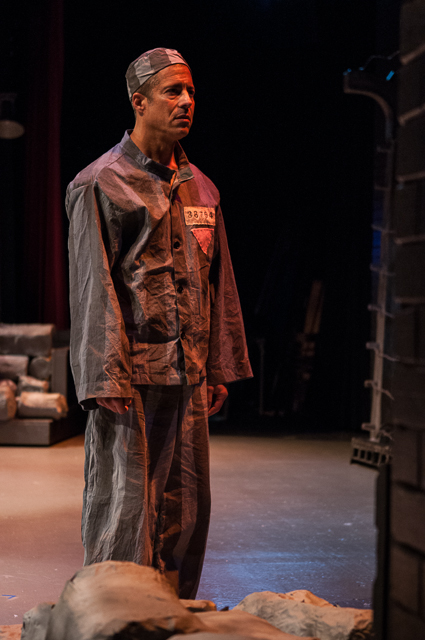
When the play was first produced, in 1979, very little knowledge about the experience of homosexuals under the Nazi régime was actually available; it is the play that in many ways spurred the research. The truth is, of course, that Jews were not the only victims systematically marked for eradication: gypsies, Jehovah’s Witnesses, the mentally handicapped, intellectuals, vagrants, prostitutes, Freemasons … and homosexuals, who were at the nadir of a list of victims, even in the rankings of fellow prisoners. Wearing a pink triangle—the public identification of gays—on one’s jacket meant to be despised by everyone.
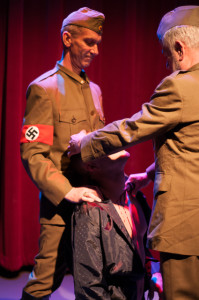 Sherman exposes that pecking order most clearly when one gay prisoner opts to wear the Star of David—even though he is not himself Jewish—rather than the pink triangle once he’s incarcerated at Dachau.
The play’s protagonist is Max, an unattractive hedonist in a very liberal 1930s Berlin who openly pursues his desires, “making deals” and drinking/drugging his way through nights at a gay club owned by drag queen Greta, much to the disappointment of his boyfriend Rudy, a dancer at the club. We meet Max and Rudy at four pm on one of many “mornings-after,” which changes dramatically when the SS storm into the flat and kill the man Max brought home with him from the club. This is the start of the Night of the Long Knives, an internal shakeup in the Nazi power structure that changes Berlin forever.
Max and Rudy flee, but are eventually caught and sent to Dachau; Max becomes even more unattractive to the audience when he is faced with the classical dilemma of the biblical Peter, and not only denies knowing Rudy but helps to kill him.
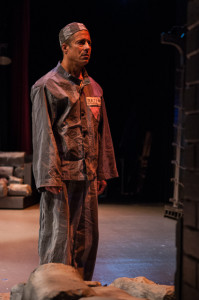 The second half of the play takes place completely at Dachau, where Max and another inmate, Horst, develop a relationship. They spend their time moving stones from one area of the camp to another before moving them back again; Max says he thinks this is designed to drive them mad.
Does Max recapture his lost humanity? What kind of relationship can develop when one cannot even talk to others, much less touch them? How does one come to terms with a limited future and a regretted past? The play poses more questions than it answers.
Steers’ casting is inspired. Bretten Burger does well with the difficult job of showing a man change through a mere two hours onstage, without losing sight that growth doesn’t necessarily entail a complete change of character; by the end of the play, he remembers that he may have once loved a dancer, but cannot remember Rudy’s name. Robert Junker, Mark Weinress, Titus Ulrich all are excellent and believable.
If I’m to single out anyone, though, it has to be Bragan Thomas, who seriously comes into his own as Rudy, making the dancer flamboyant without ever crossing into mockery.
And of course (as always) Michael Steers’ set deign is pitch-perfect. The lighting suggests more than it reveals—I was convinced at one point that there was a frosting of snow on the piles of rocks at the concentration camp—and the minimalism works well in a world where everything beloved and secure is stripped away. Steers has some very large shoes to fill in the light of past productions, and he comes through.
At a time when events in the 21st century seem to be copying those of the 20th, Bent remains an unfortunately relevant and important play. Go see it.
***
Jeannette de Beauvoir is the host of Arts Week on WOMR, a contributing writer to Provincetown Magazine, and a novelist, editor, and marketing writer. More about her at linkedin.com/in/jeannettedebeauvoir
-
Review: The Monuments Men
Posted: February 15th 2014 @10:29 AM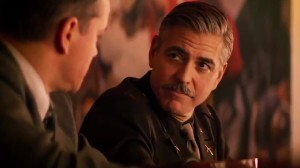 I will admit it: I’m a little obsessed with World War Two. I have some good reasons for it (I grew up in France and all of my father’s side of the family was affected by the war, some in dramatic ways) and some not-as-good reasons (it makes for great historical fiction, one of the genres in which I write). But in any case, as soon as I heard about this movie being made, I couldn’t wait to see it. I hadn’t seen its predecessor, The Train, so didn’t have a basis for comparison (as David Denby does in a not-very-flattering way in The New Yorker); and I was stoked.
My friend Michelle shook her head. “It can’t possibly live up to your expectations,” she said. And yet it did.
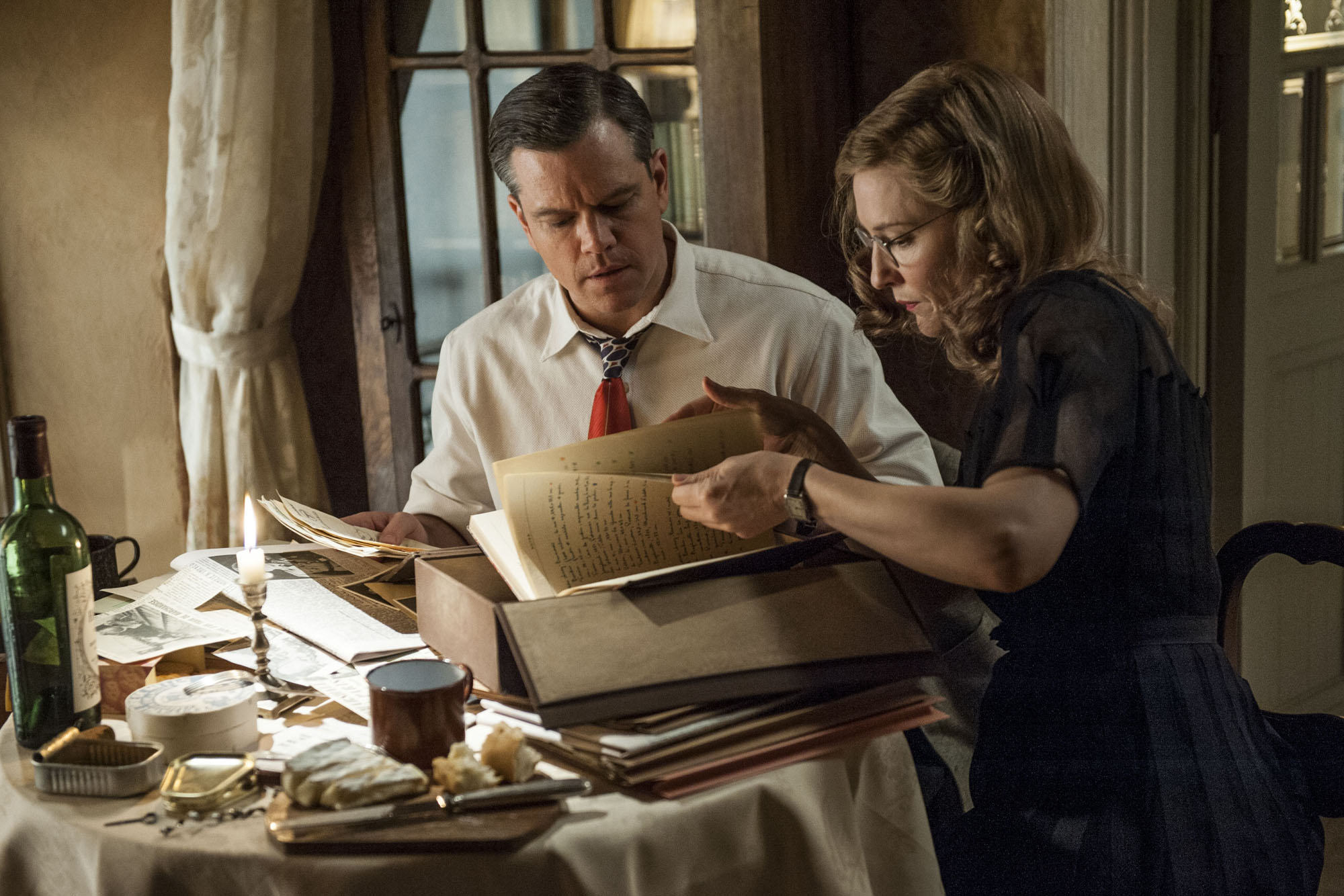
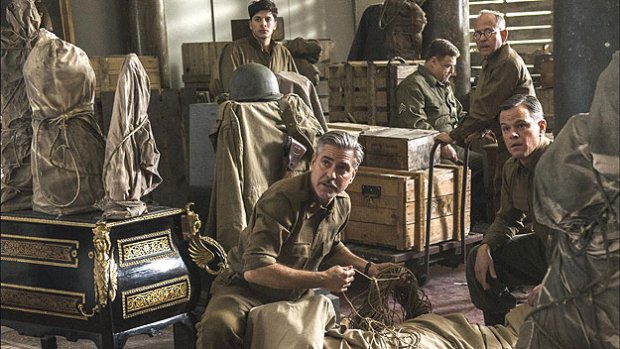
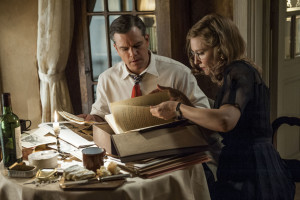 The Monuments Men is taken from Robert Edsel’s The Monuments Men: Allied Heroes, Nazi Thieves and the Greatest Treasure Hunt in History and tells the story of a small group of soldier-scholars tasked toward the end of the war to recover public and private art—cultural treasures—stolen by the German Army and the SS, to return art to its owners whenever possible, and to restore damaged artwork. This program did exist (it was officially called the Monuments, Fine Arts and Archives Group), and you can learn more about it by visiting the Monuments Men Foundation.
It seemed to be an impossible mission: with the art trapped behind enemy lines, and with the German army under orders to destroy everything as the Reich fell, how could these men—seven museum directors, curators, and art historians—hope to save any of it? The miracle is that they did. And their work lives on through the Foundation which continues to recover still-missing objects.
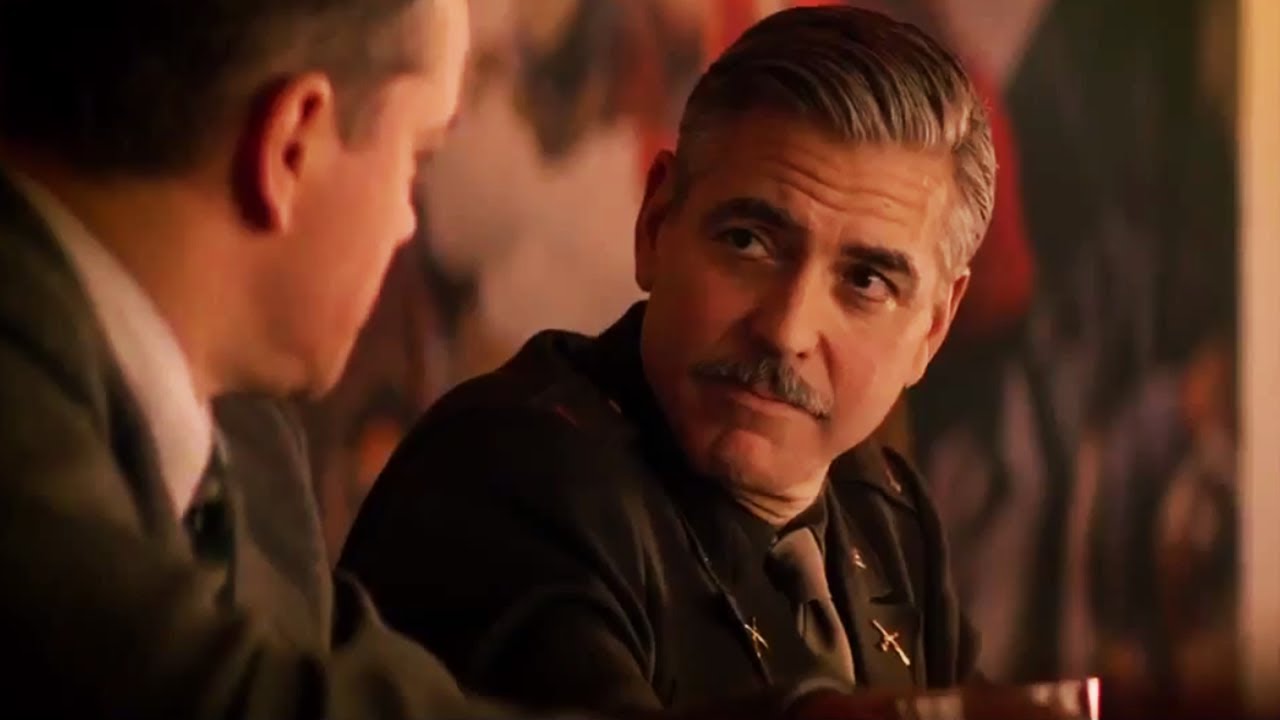
 Does the movie have flaws? Many, if you were to believe a lot of the reviews out there; but for sheer entertainment, an easy-to-swallow history lesson, and an inspiring story, I don’t think that you can beat it. The cast is impressive, featuring Matt Damon as an art restorer, Bill Murray as a Chicago architect, John Goodman as a sculptor, Jean Dujardin as a French painting instructor, Hugh Bonneville (Lord Grantham, anyone?) as a British museum head, and Bob Balaban as a theatre impresario… an unlikely group of people to become heroes. Cate Blanchett joins the cast to play a Parisian “collaborator” and assistant curator from the Jeu de Paume national gallery who knows where much of the stolen artwork is but won’t tell the Allies because she fears that they won’t return it to France.
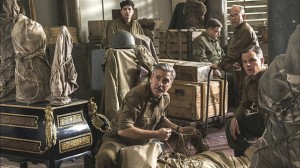 Two of the crew will die in their attempt to save the world’s priceless cultural heritage, thus bringing into play the central question of the film: is priceless indeed the right word for these treasures? Is art—no matter how great—worth the loss of human life? The movie purports to find the answer, leaving it up to the viewer to see if they agree.
Oh, and a final note: don’t get too upset about the Germans looting Europe’s oldest and most valuable treasures: there is nothing new under the sun, and Americans watching the movie would do well to remember the far more recent looting of Baghdad’s own priceless cultural art treasures—by U.S. troops.
***
Jeannette de Beauvoir is the host of Arts Week on WOMR, a contributing writer to Provincetown Magazine, and a novelist, editor, and marketing writer. More about her at linkedin.com/in/jeannettedebeauvoir